

Không có sản phẩm nào trong giỏ hàng của bạn
19/09/2026
Admin
PharmApp · Research & Development
VinaDiscovery
AI-Powered Computer-Aided Drug Discovery Platform
Discover. Predict. Design. Prioritize.
From Molecular Data to Drug Discovery Decisions.
From molecular data to discovery decisions
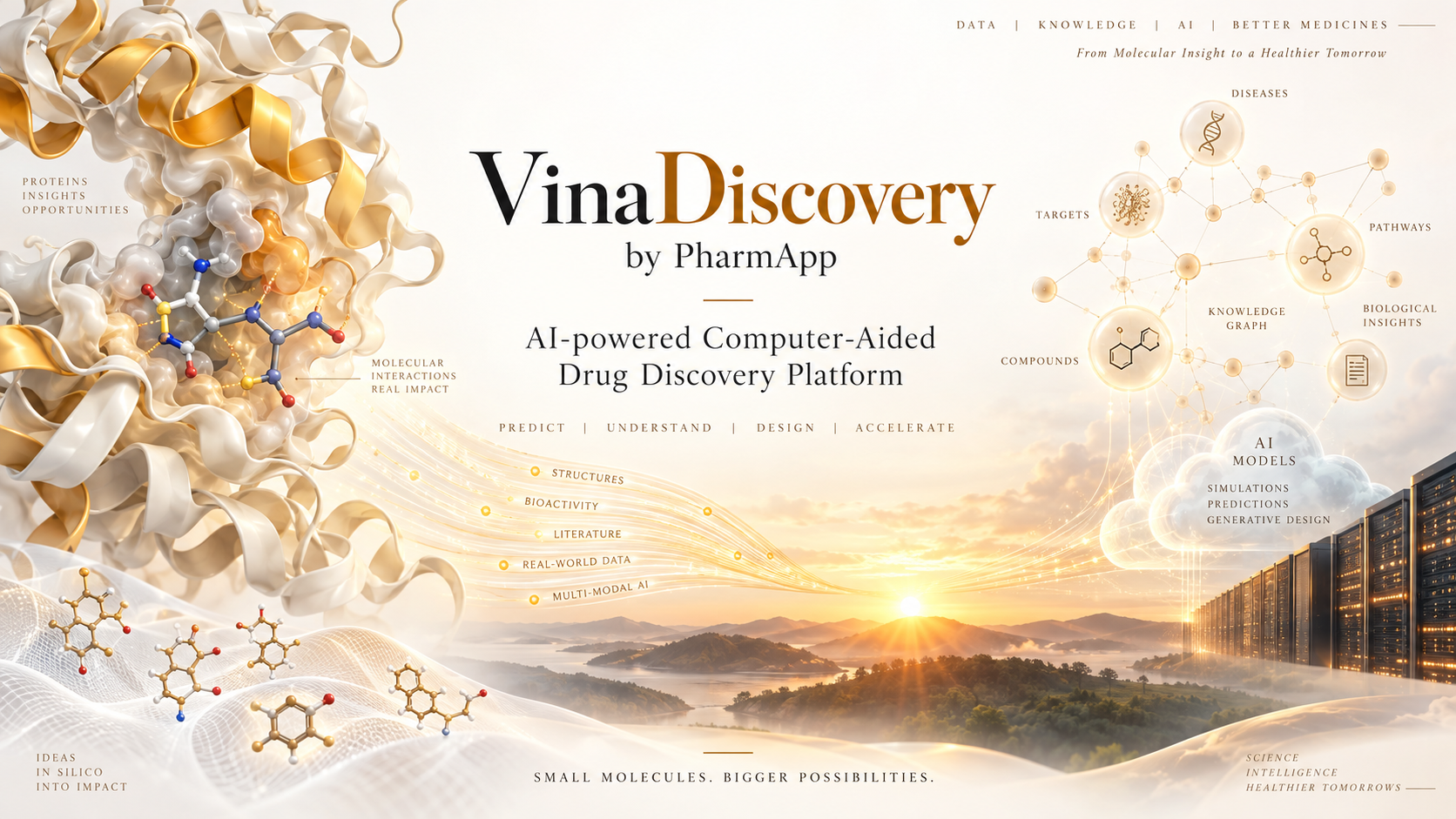
VinaDiscovery is an integrated scientific computing platform for modern drug discovery, combining cheminformatics, artificial intelligence, structural biology, molecular simulation, ADME, safety intelligence, medicinal chemistry, and synthesis planning in a unified research environment.
The platform is designed to move beyond isolated molecular calculators toward a connected workflow where molecules, models, simulations, evidence, uncertainty, and project context can be linked and traced throughout the research process.
A promising molecule is not defined by a single score. Drug discovery requires coordinated evidence across structure, biology, physics, developability, safety and design.
Scientific architecture
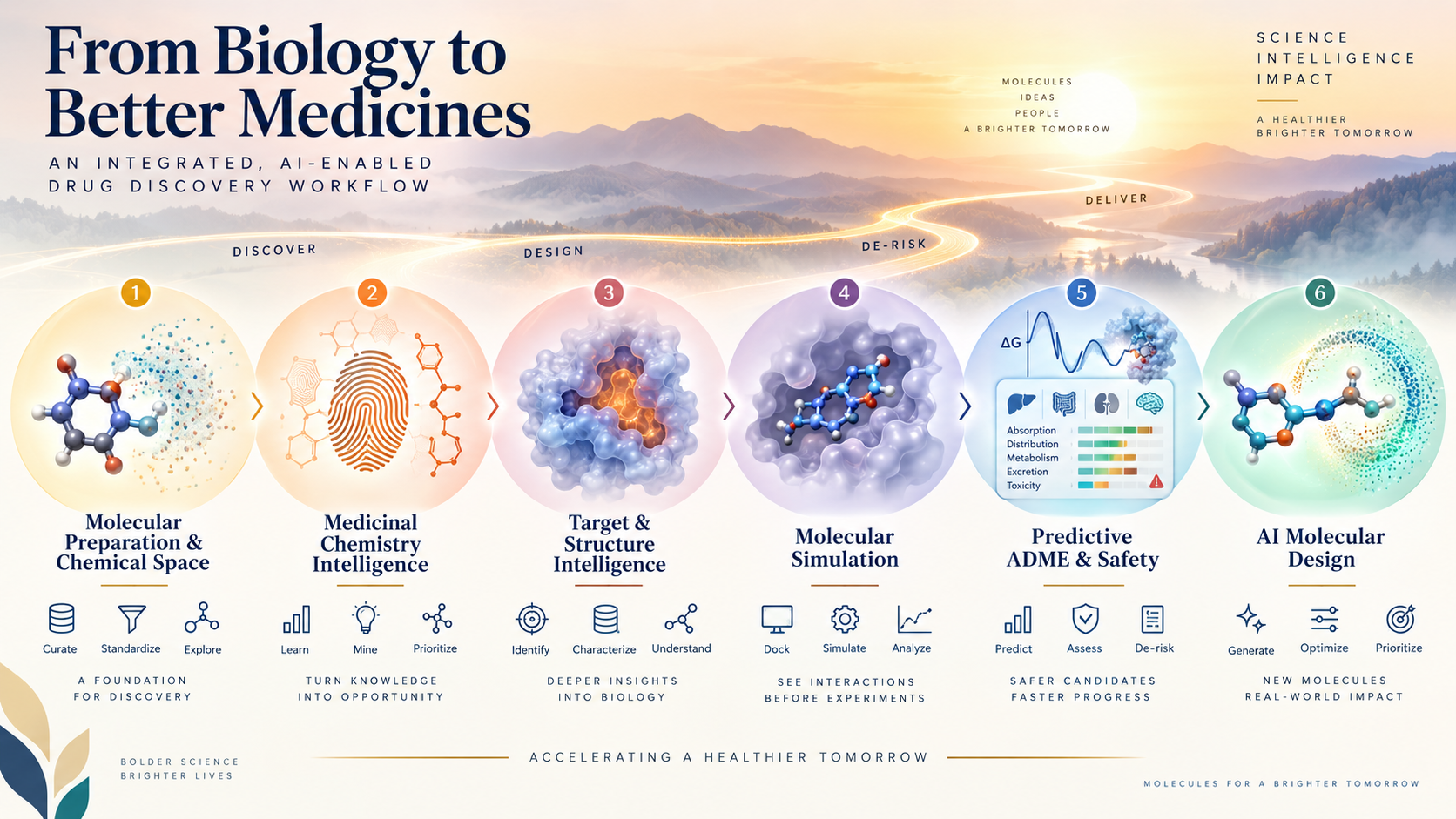
VinaDiscovery is organized into six scientific layers so that individual capabilities remain modular while interoperating through shared scientific data and workflows.
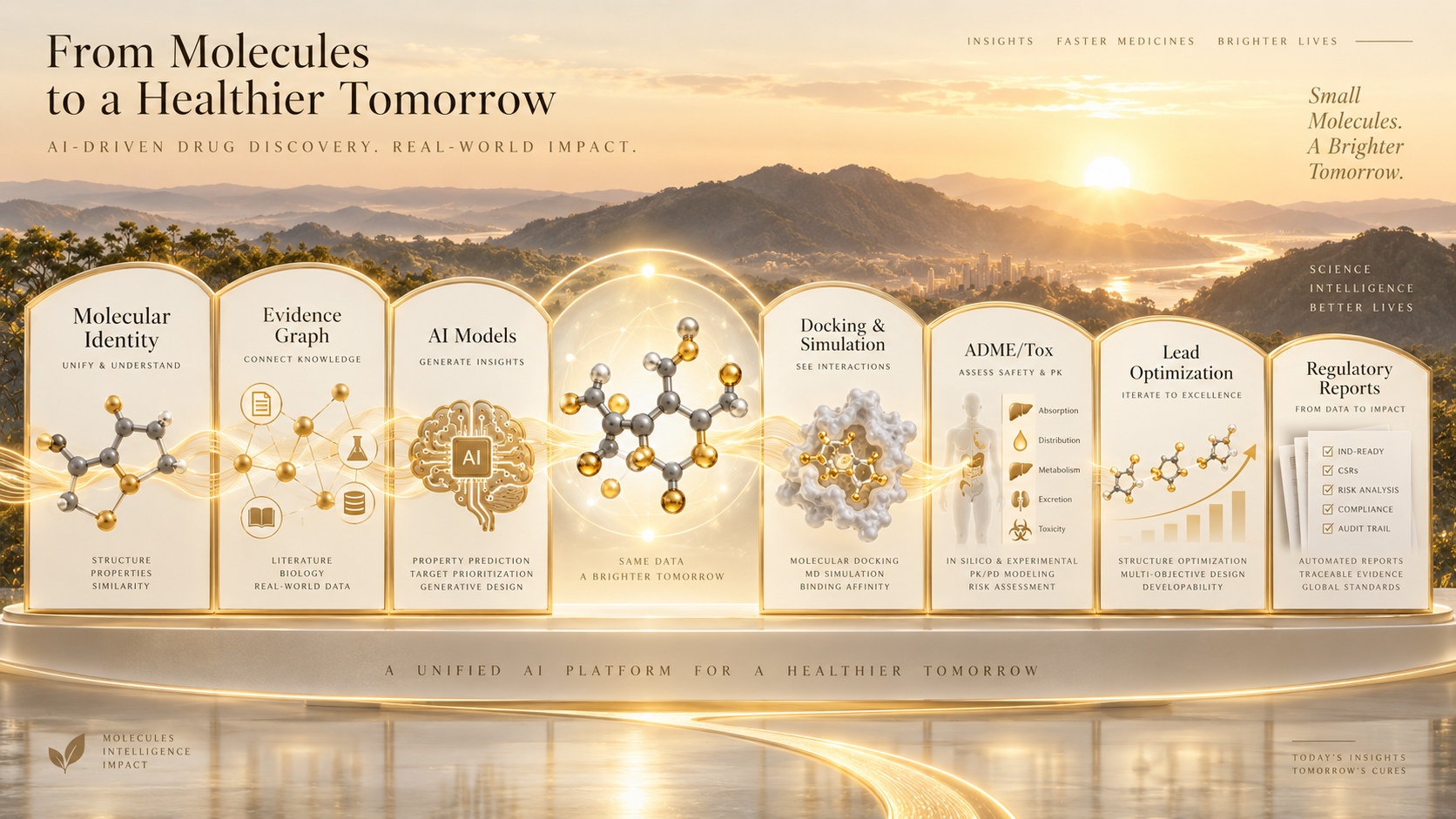
| Scientific layer | Flagship capabilities |
|---|---|
| Molecular Preparation & Chemical Space | VinaMolPrep · VinaSimilarity · VinaChemSpace |
| Medicinal Chemistry Intelligence | VinaMMP · VinaBioisostere · VinaPharmacophore |
| Target & Structural Intelligence | VinaTarget · VinaPocket · VinaBind · VinaInteract |
| Molecular Simulation & Physics | VinaParam · VinaMD · VinaFEP |
| Predictive ADME & Safety Intelligence | VinaQSAR · VinaADME · VinaTox |
| AI Molecular Design | VinaLeadOpt · VinaDeNovo · VinaSynthesis · VinaSidechain |
Core scientific capabilities
VinaMolPrep
Molecular preparation and structure standardization
VinaSimilarity
Ligand similarity and virtual screening
VinaChemSpace
Chemical-space exploration, clustering and diversity analysis
VinaMMP
Matched molecular pair analysis and transformations
VinaBioisostere
Data-driven molecular replacement
VinaPharmacophore
Ligand- and structure-based pharmacophore intelligence
VinaTarget
AI target prediction and target fishing
VinaPocket
Binding-site and pocket intelligence
VinaBind
Molecular docking and binding-pose hypotheses
VinaInteract
Protein–ligand interaction analysis
VinaParam
Molecular force-field parameterization
VinaMD
Molecular dynamics simulation
VinaFEP
Free-energy workflows
VinaQSAR
Machine-learning molecular property modelling
VinaADME
ADME and drug-likeness intelligence
VinaTox
Toxicity and safety intelligence
VinaLeadOpt
Multi-parameter lead optimization
VinaDeNovo
Generative molecular design
VinaSynthesis
Retrosynthesis and synthetic route planning
VinaSidechain
Non-natural amino-acid and sidechain intelligence
Molecular preparation & chemical intelligence
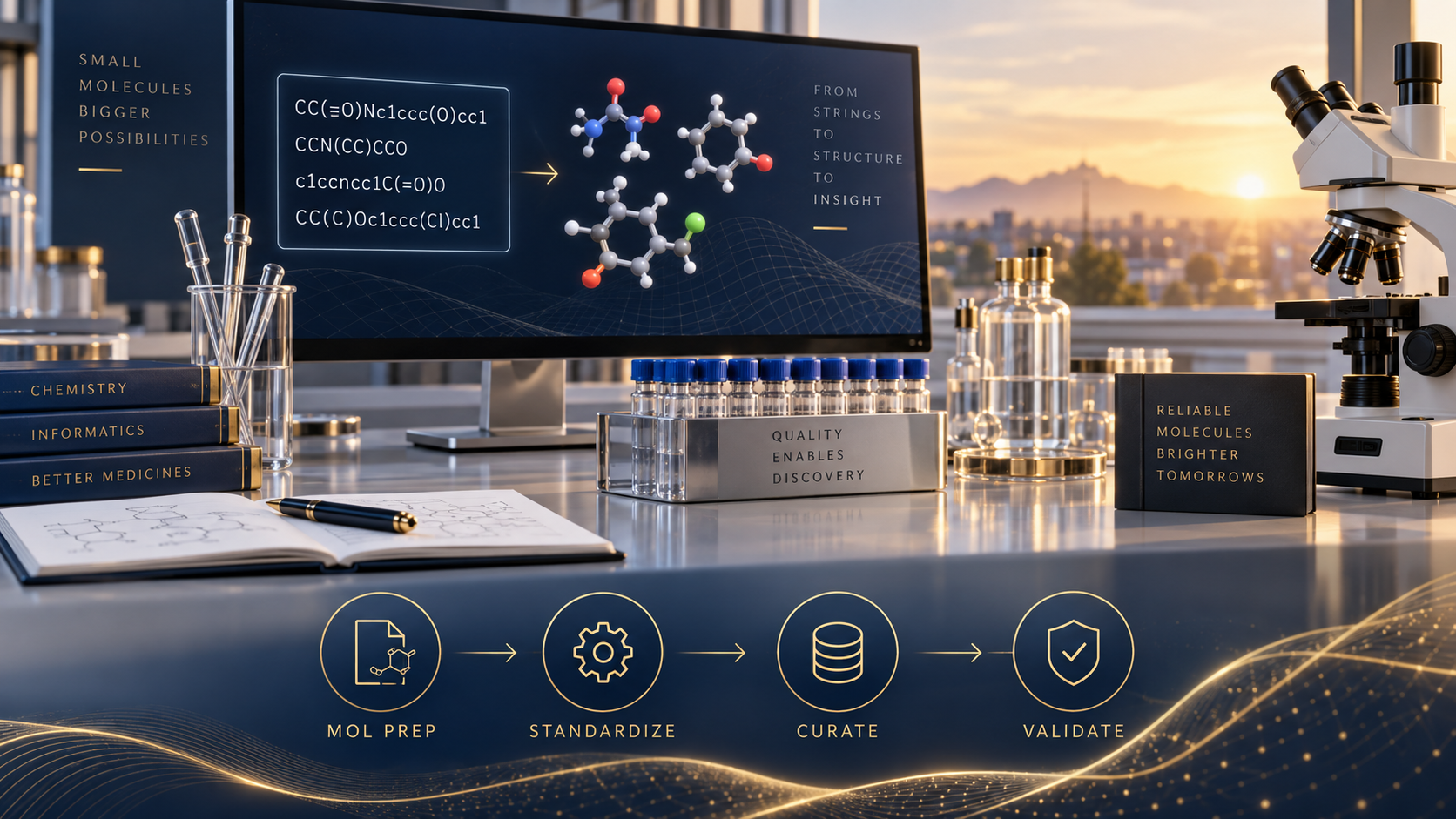
VinaMolPrep establishes a consistent molecular identity for downstream computation. Typical preparation can include validation, normalization, tautomer and protonation-state handling, stereochemistry checks, conformer generation and charge preparation.
VinaSimilarity
Nearest-neighbor search, analog identification, virtual screening and similarity-based exploration.
VinaChemSpace
Clustering, diversity, scaffold distributions, property landscapes and chemical-space visualization.
Target & structural intelligence
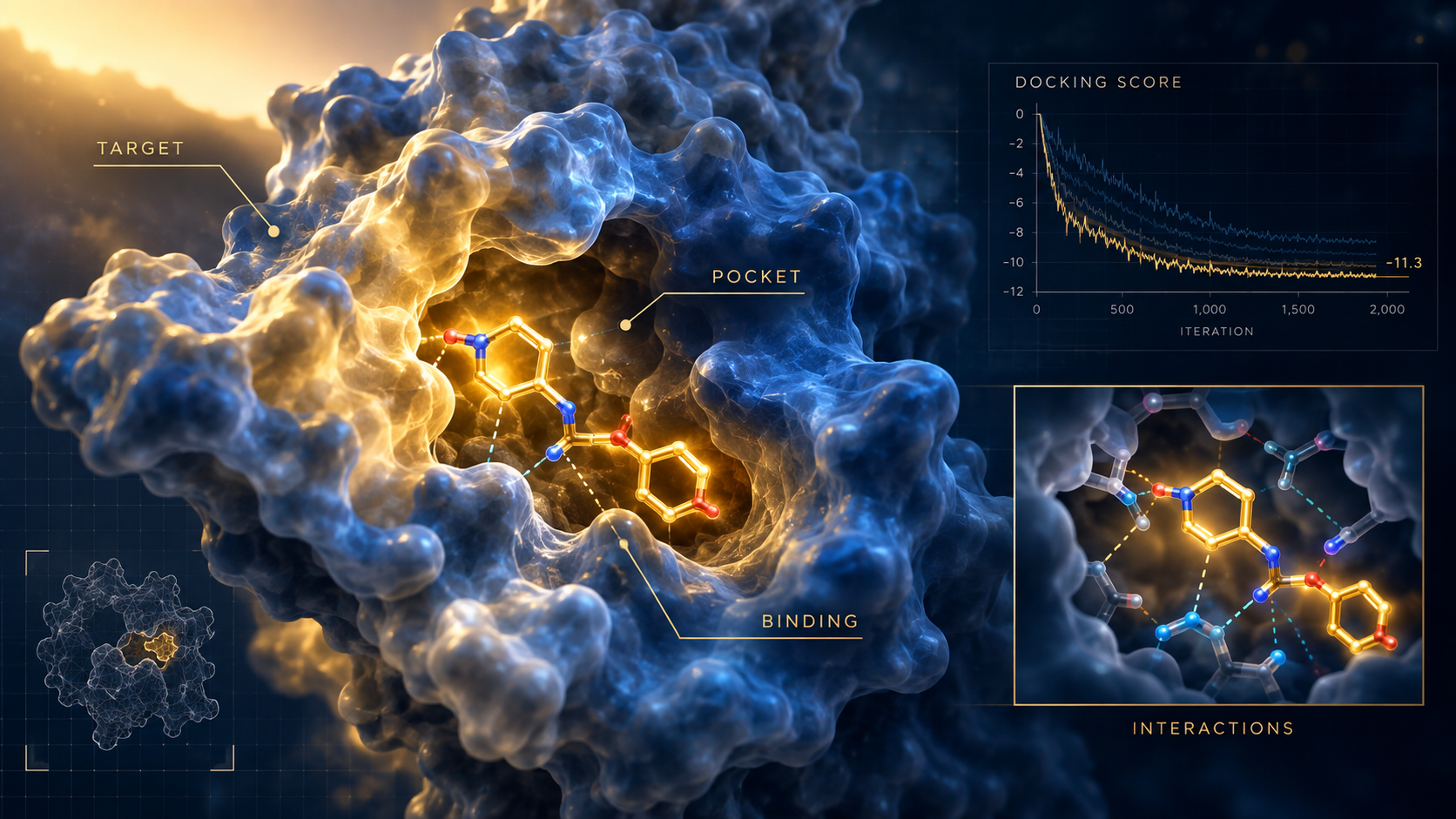
VinaTarget, VinaPocket, VinaBind and VinaInteract connect molecular hypotheses with structural biology.
Target hypotheses
Chemical similarity, bioactivity, molecular representations, protein representations and structural evidence can be combined to support ranked hypotheses.
Binding hypotheses
Pocket identification, binding poses, docking scores and protein–ligand interaction analysis form a traceable structural workflow.
Predictive ADME & safety intelligence
VinaQSAR, VinaADME and VinaTox support computational triage and developability assessment.
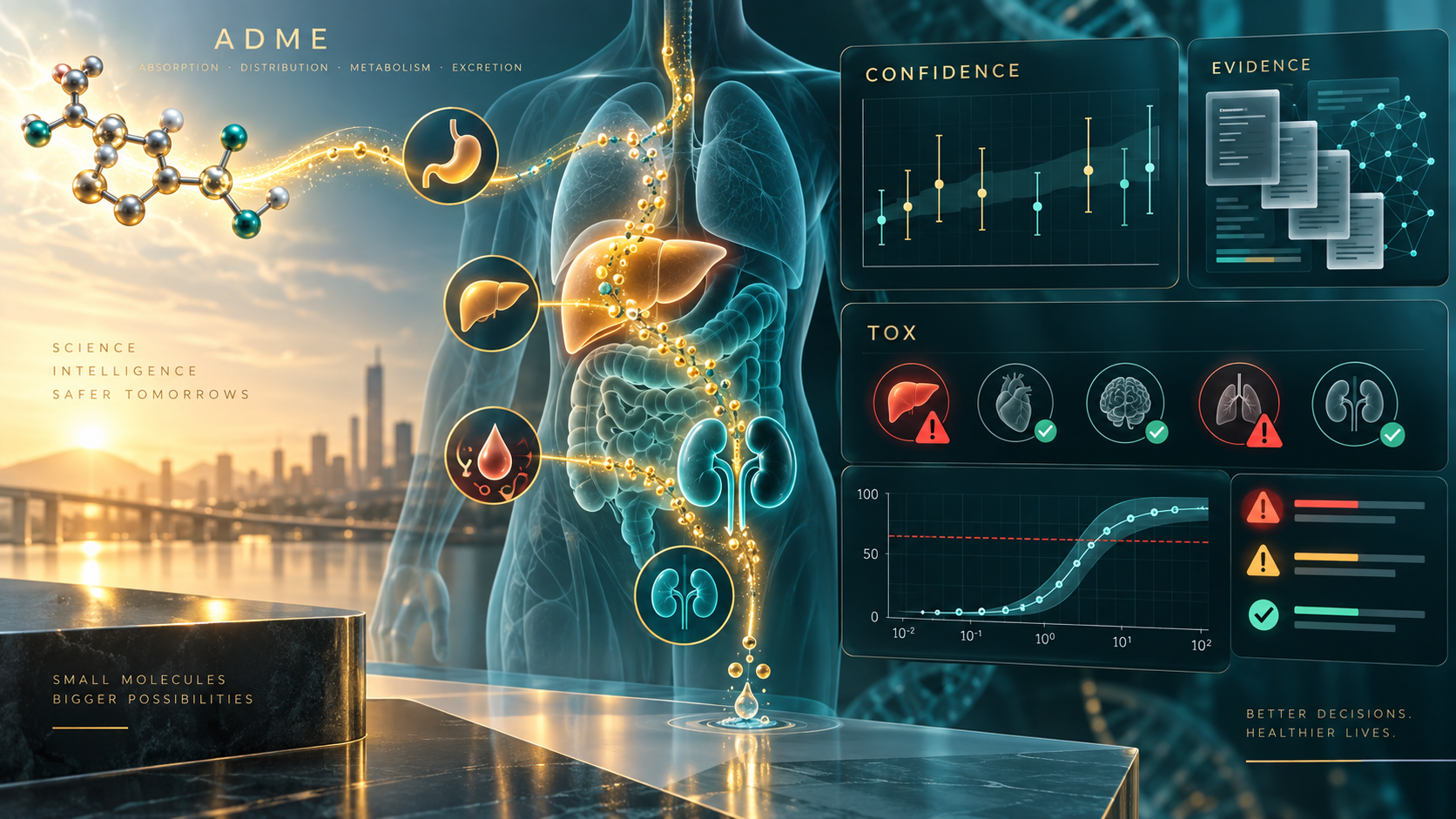
Physicochemical propertiesSolubilityPermeability
Metabolic propertiesDrug-likenessSafety endpoints
UncertaintyApplicability domain
AI molecular design & synthesis
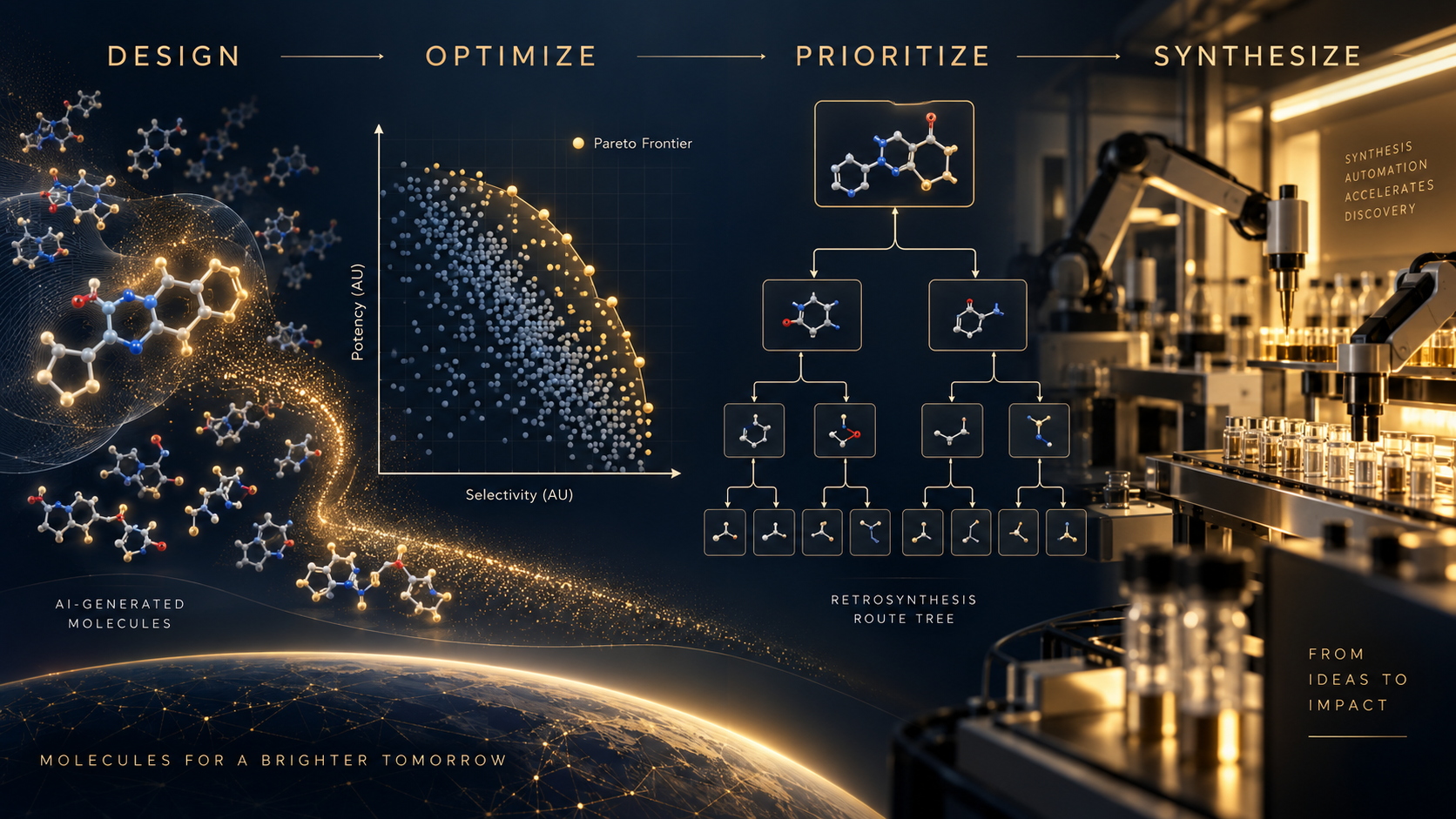
VinaLeadOpt, VinaDeNovo, VinaSynthesis and VinaSidechain extend the platform from prediction into molecular design and synthesis planning.
Multi-parameter optimization
Balance potency, selectivity, solubility, safety, metabolic liability, novelty and synthetic feasibility.
Generative design
Generate candidates under structural and property constraints, then evaluate them through downstream scientific workflows.
Synthesis bridge
Connect computationally designed molecules with retrosynthesis, building blocks and route feasibility evidence.
End-to-end discovery workflow
The platform is designed so that results from one layer can become evidence or inputs for the next.
Molecular Data
      │
      ▼
Molecular Preparation
      │
      ▼
Chemical Space & Similarity
      │
      ▼
Target Intelligence
      │
      ▼
Binding Site Intelligence
      │
      ▼
Molecular Binding
      │
      ▼
Interaction Analysis
      │
      ▼
Molecular Simulation
      │
      ▼
Free-Energy Analysis
      │
      ▼
ADME & Safety
      │
      ▼
Lead Optimization
      │
      ▼
Molecular Design
      │
      ▼
Synthesis Planning
Data, AI & physics
VinaDiscovery brings together complementary computational modes rather than treating AI as a replacement for scientific modelling.

Data
Molecular identities, bioactivity, structures, transformations, evidence and scientific artifacts.
AI / ML
Representation learning, predictive modelling, target hypotheses and molecular design.
Physics
Docking, molecular mechanics, molecular dynamics and free-energy workflows.
Scientific integrity
VinaDiscovery explicitly distinguishes Experimental, Calculated, Predicted, Inferred, and Literature-Derived information.
Traceability
Results should retain input structures, model versions, dataset versions, parameters, software versions, uncertainty and provenance where applicable.
Responsible interpretation
Docking scores are ranking signals, predictions are not experimental measurements, target hypotheses are not confirmed mechanisms, and computational safety results do not replace experimental toxicology.
Validation philosophy
Different scientific modules require different validation strategies. Model performance should be evaluated in the context of the intended use case and data distribution.
| Module group | Example validation focus |
|---|---|
| Similarity / Chemical Space | Neighbour relevance, enrichment, scaffold recovery |
| Target Prediction | Top-k recall, PR-AUC, temporal and external validation |
| Molecular Binding | Pose RMSD, enrichment and benchmark evaluation |
| Interaction Analysis | Recovery against experimental structures |
| Parameterization | Energy and geometry agreement with validated references |
| Molecular Dynamics | Trajectory stability and experimental observables where available |
| Free Energy | Error against experimental ΔG / ΔΔG |
| QSAR / ADME | Scaffold, temporal, external validation and calibration |
| Toxicity | Sensitivity, specificity, PR-AUC and external evaluation |
| Molecular Design | Validity, novelty, uniqueness and property success |
| Synthesis Planning | Route validity, feasibility and expert review |
Evidence-aware scientific results
A computational result should be treated as a scientific record rather than an isolated number.
{
  "value": 0.83,
  "unit": "probability",
  "method": "model",
  "model_version": "1.0.0",
  "dataset_version": "2026.09",
  "input_structure_id": "structure-id",
  "uncertainty": 0.07,
  "applicability_domain": "in-domain",
  "evidence_count": 124,
  "provenance": {},
  "warnings": []
}
Toward a unified molecular intelligence environment
The long-term direction is to connect individual models into integrated workflows, then into evidence-aware decision support and closed-loop molecular design.

Why this molecule? Why this target? Why this binding mode? What evidence supports it? How uncertain is the prediction? What should be tested next?


